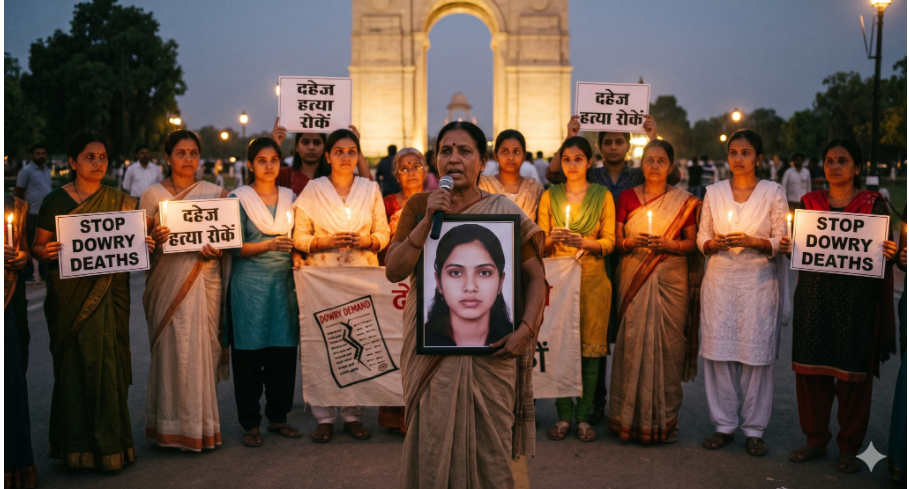
How Many Dowry Deaths Happen in India Every Year — NCRB Data Explained
The numbers are hard to read, but they matter. Every year, thousands of women in India lose their lives because of dowry-related violence. These are not old stories. This is happening right now, in families across the country. Understanding the scale of this crisis is the first step toward changing it.
This article draws entirely from official NCRB (National Crime Records Bureau) data. Every figure here is verifiable.
What NCRB Data Tells Us About Dowry Deaths in India
The National Crime Records Bureau publishes an annual report called Crime in India. It tracks dowry deaths under Section 304B of the Indian Penal Code, which covers deaths linked to dowry harassment within seven years of marriage.
According to the NCRB's Crime in India 2024 report, India recorded 5,737 dowry deaths that year — an average of 15 to 16 lives lost every single day.
The year before was worse. In 2023, a total of 6,156 people lost their lives in dowry death cases, according to NCRB data. That is one death roughly every 85 minutes.
Year-on-Year Trend: Are Numbers Going Up or Down?
| Year | Dowry Deaths (NCRB) | Dowry Prohibition Act Cases |
|---|---|---|
| 2021 | Data per NCRB report | 13,568 |
| 2022 | 6,450 | 13,479 |
| 2023 | 6,156 | 15,489 |
| 2024 | 5,737 | Data pending full release |
Dowry-related crime cases registered under the Dowry Prohibition Act rose to 15,489 in 2023 — up from 13,479 in 2022 and 13,568 in 2021, a 14 per cent increase in a single year.
So while recorded deaths dipped slightly from 2023 to 2024, reported cases of dowry crimes went up sharply in 2023. This gap matters. It likely reflects better reporting, not a reduction in actual violence.
Which States Have the Most Dowry Deaths?
The data is not spread evenly across India. A few states account for the vast majority of cases.
Uttar Pradesh had the highest number of dowry deaths in 2023 with 2,122 deaths, followed by Bihar with 1,143.
Four states — Uttar Pradesh, Bihar, Madhya Pradesh, and Rajasthan — account for nearly 65 per cent of India's dowry deaths.
This concentration points to a regional pattern. These states share high rates of early marriage, lower female workforce participation, and stronger social pressure around dowry as a condition of marriage.
State-Wise Dowry Death Overview (2023, NCRB)
| State | Dowry Deaths (2023) | Share of National Total |
|---|---|---|
| Uttar Pradesh | 2,122 | ~34% |
| Bihar | 1,143 | ~19% |
| Madhya Pradesh | Part of top 4 | High |
| Rajasthan | Part of top 4 | High |
| Delhi (among metros) | 114 | Highest among metros |
Among India's 19 metropolitan cities, Delhi reported the highest number of dowry deaths in 2023 with 114 cases, and also recorded the most cases of cruelty by husband at 4,219.
Why Some States Report Zero Cases
Thirteen states and Union Territories — including West Bengal, Goa, Arunachal Pradesh, Ladakh, and Sikkim — reported zero dowry cases during 2023.
This does not mean dowry violence does not happen in these places. It means cases are not being filed. Researchers and legal experts consistently point out that low reporting is a bigger problem than low incidence in many regions.
Experts note that social stigma, fear of family backlash, and lack of faith in the justice system stop many victims from filing complaints. In high-prevalence states, police have also been known to delay investigations or misclassify dowry deaths as suicides.
Dowry Suicides: A Separate but Connected Crisis
Dowry deaths under Section 304B cover cases where a woman is killed or dies under suspicious circumstances. But there is a second category that often gets less attention: dowry-related suicides.
NCRB's Accidental Deaths and Suicides in India 2024 report showed a 6.7 per cent rise in dowry-related suicide cases, from 1,587 in 2023 to 1,693 in 2024.
These are women who were not murdered, but were pushed to take their own lives because of harassment, cruelty, and financial pressure at home. The law and the data treat these as separate categories, but the cause is the same.
Are Dowry Deaths Underreported?
Almost certainly, yes. The NCRB figures represent cases that were registered with police and recorded under the correct sections. Many cases never reach that stage.
Researchers have pointed out that dowry deaths are often misreported as accidental deaths, which means the actual number of women who die following dowry harassment is likely much higher than official figures show.
A woman who dies in a kitchen fire, or who is found dead at home, may be a dowry death that gets recorded as an accident. This happens because families on both sides sometimes prefer to avoid legal proceedings, and because police in some areas do not investigate thoroughly.
What the Law Says — and Why It Is Not Enough
India has some of the strictest dowry laws in the world on paper. Section 304B IPC covers dowry death. Section 498A IPC covers cruelty and harassment. The Dowry Prohibition Act 1961 makes giving and taking dowry a criminal offence.
Despite the Dowry Prohibition Act being in force since 1961, the practice persists in both open and disguised forms — from cash and property demands to pressure for luxury gifts presented as voluntary contributions.
Enforcement is weak. Social acceptance is strong. And many families continue to treat dowry as tradition rather than crime.
What Families Can Do Differently
If you are in the process of finding a match — for yourself or your child — these numbers are a reminder of what is at stake when financial demands enter a marriage negotiation.
Here is what you can do:
- Refuse any discussion of dowry during match-viewing. If a family brings up "what the girl's side will give," treat it as a serious warning sign about their values.
- Document any financial demands made before or after engagement. This protects you legally if the situation escalates.
- Speak openly within your own family. Many parents agree to dowry demands out of silence and fear, not genuine willingness.
- Know your legal rights. Dowry demands are illegal. You can report them to a Dowry Prohibition Officer or call the national women's helpline at 181.
- Choose partners based on character, not credentials. A man's degree or salary does not predict how he or his family will treat your daughter.
How Matrimony Platforms Can Help
One of the least-discussed tools for reducing dowry pressure is how you find a match in the first place. When families search for partners through a platform that prioritises compatibility — values, communication, family culture, life goals — the financial negotiation tends to take a back seat.
Marriage Jodi is built around that approach. Profiles focus on who a person is, not what their family expects to receive. The conversations that begin here tend to start from a more equal, respectful place.
Thousands of families have found genuine matches through Marriage Jodi — without financial conditions attached. That is the kind of matrimony that has a real chance of lasting.
The Bigger Picture
Six thousand deaths in a single year. Fifteen-plus deaths every day. These are not abstract statistics. Each number is a woman who had a life ahead of her.
The data shows this is not a disappearing problem. It is widespread, under-reported, and deeply connected to how Indian society still values women in the context of marriage. Changing it starts with awareness — and with every family that decides, clearly and firmly, that a person's worth is not measured in what their parents pay.