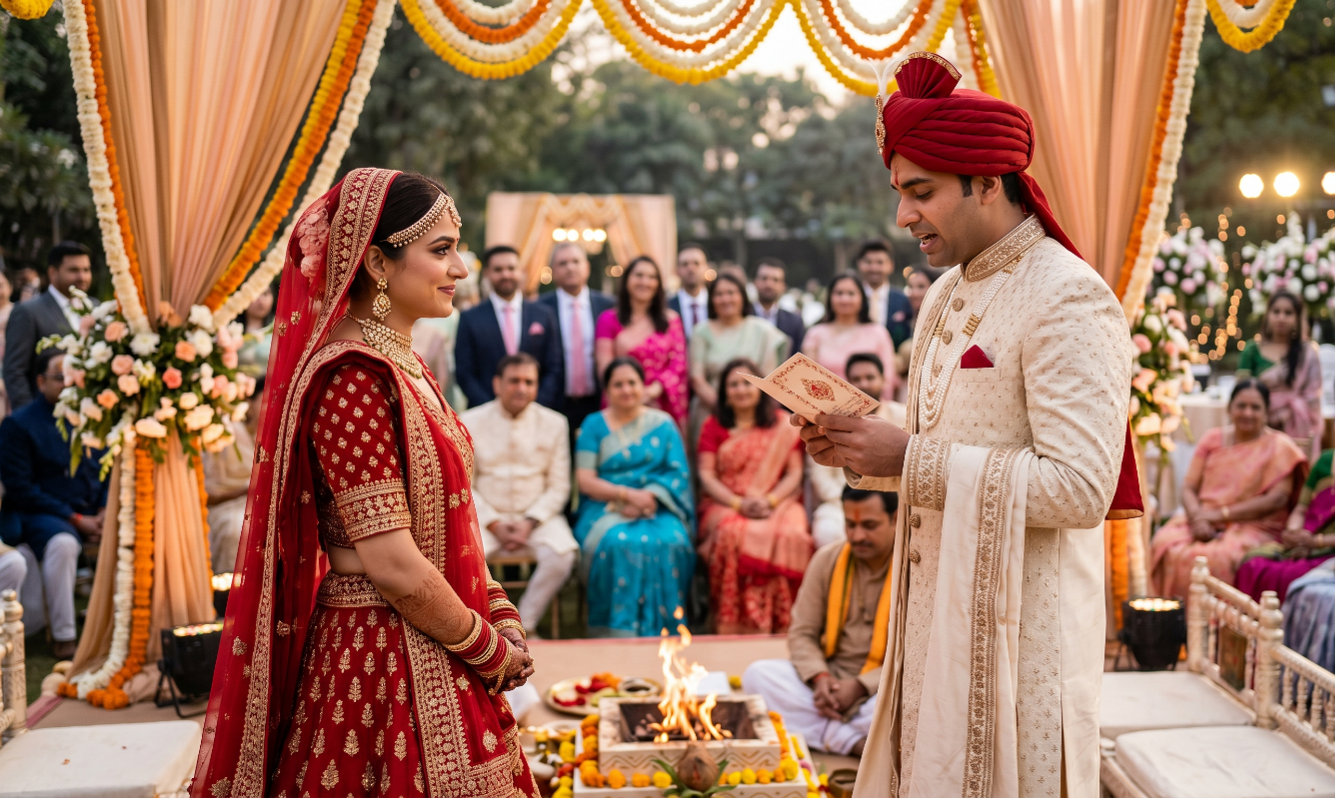
How to Write Wedding Vows That Feel Personal, Genuine, and Yours
Wedding vows are the words your partner will remember long after the flowers have wilted and the food is forgotten. They are the heart of the ceremony. So it makes sense that writing them feels equal parts meaningful and nerve-wracking.
Most people have never written wedding vows before. You know what you feel, but translating that into spoken words that do not feel awkward or cliched is harder than it sounds. That is exactly what this guide is for.
Whether you are the bride writing vows for him, the groom writing vows for her, or a couple doing this together for the first time, this guide walks you through the entire process with examples, a template, and honest advice.
How Do You Start Writing Wedding Vows?
The biggest mistake people make is opening a blank document and trying to write the vows from scratch. That rarely works. Starting with reflection works far better than starting with writing.
Before you write a single word, spend 20 to 30 minutes answering these questions on paper. Do not worry about how they sound. Just write honestly.
- When did you first realise this was the person you wanted to marry?
- What specific quality in your partner do you admire most?
- Name one time they showed up for you in a way you will never forget.
- What does your life look like because of them?
- What are you genuinely promising them for the years ahead?
Once you have answered these, you have raw material. Your vows will come from this material, not from borrowed phrases or templates you found online. The most moving vows are specific to the two of you.
Wedding Vow Template: A Simple Structure That Works
Good wedding vows follow a simple structure. They open with your partner, move into your story, name what you love, make real promises, and close with a declaration. The table below maps this out clearly.
| Vow Section | What to Include | Approx Length |
|---|---|---|
| Opening line | Start with their name or a direct address to your partner | 1 to 2 sentences |
| Your story | A specific memory, moment, or quality that matters to you | 2 to 3 sentences |
| What you love | Name concrete qualities, not vague feelings | 2 to 3 sentences |
| Your promises | 3 to 5 specific, honest commitments | 3 to 5 sentences |
| Closing declaration | End with a clear statement of love and commitment | 1 to 2 sentences |
| Total target length | Spoken out loud at a comfortable pace | 90 to 150 seconds (roughly 200 to 350 words) |
Keep your vows between 200 and 350 words. That reads out in about 90 to 150 seconds, which is the right length for a ceremony. Shorter can feel too thin. Longer can test the crowd's attention and make you more likely to stumble when nerves kick in.
Write them out fully, then read them aloud three to four times. Your voice will find where the rhythm is off and where a sentence is too long to say comfortably.
How to Write Wedding Vows for Him: Groom's Guide
Many grooms find vow writing difficult because they are not used to expressing emotion in formal language. The key is to stop trying to sound poetic and start trying to sound honest.
Think of the vows as a private letter spoken in public. Write the way you would talk to your partner when no one else is around. That tone, direct and warm without performance, is what lands.
Unique Wedding Vow Examples for Him
"I used to think I had everything figured out. Then you came in and showed me how much better things could be. I promise to keep learning from you, to laugh with you even when things are hard, and to choose you deliberately, every single day."
"You make ordinary days feel like something worth remembering. I promise to show up for you the way you have always shown up for me. I promise to be honest, to be present, and to be the person you deserve to come home to."
Notice that both examples use specific language rather than vague declarations. They name what the partner does and make concrete promises. That specificity is what makes vows feel real instead of rehearsed.
Wedding Vows for Her: How to Write Vows From Her to Him
Wedding vows from the bride often carry an emotional weight that the setting amplifies. If you tend to get emotional, that is not a problem. Most guests and your partner will find it moving. The issue is only if you lose your place because of it.
Write vows that you can get through even with a full voice. Avoid sentences that are so tender they bring you to tears before you finish them. Read them aloud in front of a mirror or a trusted friend a few times before the day.
Wedding Vows for Her: Example
"I never knew what it felt like to be truly known by another person until I met you. You see me on the days I cannot see myself, and you stay. I promise to match that. I promise to love you with patience, to be your steady ground, and to build a life with you that we are both proud of."
This example works because it acknowledges the partner's specific quality, makes a matching promise, and ends with a shared vision. Vows that end with 'us' rather than 'you' or 'I' tend to feel more complete.
Choosing Your Vow Tone
Not every couple wants deeply emotional vows. Some want warmth with lightness. Others want poetic language. The tone should match who you are as a couple, not what you think a wedding ceremony requires.
| Vow Tone | Best For | Example Opening |
|---|---|---|
| Heartfelt and sincere | Couples who prefer emotional depth | "From the day I met you, I knew something had shifted in me permanently." |
| Light and warm | Couples who want humour balanced with love | "I promise to always let you have the last bite. Almost always." |
| Simple and direct | Couples who prefer clear, plain language | "I choose you today and every day after this." |
| Poetic or lyrical | Couples with a love of literature or language | "You are the quiet at the end of every hard day." |
| Christian / faith-based | Church weddings, faith-centred couples | "Before God and these witnesses, I take you as my partner for life." |
If you choose to include humour, keep it brief and kind. One light moment in your vows can make the ceremony feel human and relaxed. But vows that are mostly jokes risk undercutting the sincerity of the moment.
Discuss the tone with your partner beforehand so you are not wildly mismatched. One deeply serious speech and one full of jokes can feel unbalanced to everyone watching.
How to Write Christian Wedding Vows
Christian wedding vows are typically exchanged in the presence of God, a priest or pastor, and witnesses. Many churches have a standard vow format that they require or expect. Always check with your officiant first before writing custom vows.
If your church allows personal vows, the structure is the same as any personal vow but should include an acknowledgement of God's role in the marriage and a reference to the lifelong nature of the commitment.
How to Start Christian Wedding Vows
"Before God, and before these witnesses who love us, I take you as my husband and my partner for life. I believe that God brought us to each other, and I choose to honour that gift every day."
Christian vows often include promises around faith, patience, and faithfulness. If your church has a standard format, you can personalise the middle portion while keeping the opening and closing language aligned with the ceremony's religious tone.
What Are the Basic Vows for a Wedding?
The most widely recognised wedding vow in English comes from traditional Protestant ceremonies. The language is simple and has endured for centuries because it covers the essentials clearly.
"I take you to be my lawfully wedded partner, to have and to hold, from this day forward, for better, for worse, for richer, for poorer, in sickness and in health, to love and to cherish, until death do us part."
These basic vows work because they are direct, complete, and easy to memorise. They name both the joyful and difficult parts of life together, which is honest. Many couples use this as a foundation and add personal lines before or after.
What Are the 7 Promises in Marriage?
In Hindu weddings, the Saptapadi or seven steps is the ritual at the heart of the marriage. The couple takes seven steps together around the sacred fire, and with each step they make one of seven promises to each other. These are the traditional seven vows of Hindu marriage.
- The first step is for nourishment: a promise to provide and care for each other.
- The second step is for strength: a promise to stand by each other through difficulties.
- The third step is for prosperity: a promise to work together and share wealth.
- The fourth step is for happiness: a promise to fill the home with joy and respect.
- The fifth step is for family: a promise to care for children and elders.
- The sixth step is for health: a promise to look after each other's wellbeing.
- The seventh step is for friendship: a promise to remain companions and confidants for life.
These seven promises are not just rituals. They are a complete framework for a shared life. Many modern Hindu couples now include a translated or adapted version of the Saptapadi in their wedding ceremony alongside personal vows so both the traditional and the personal are honoured.
Practical Tips Before the Wedding Day
- Write your first draft at least three weeks before the wedding. Give yourself time to revise.
- Read your vows aloud at normal speaking pace. What reads well silently often sounds rushed when spoken.
- Do not memorise your vows. Bring a printed card. Nerves affect memory, and reading from a card is completely acceptable.
- Use a font size large enough to read under ceremony lighting without squinting.
- Do not share your vows with your partner before the ceremony unless you both want to. Hearing them for the first time at the altar is more meaningful for most couples.
- Keep a spare copy with someone you trust, like your best man or maid of honour, in case you misplace yours.
Frequently Asked Questions
How do you start writing wedding vows?
Start by answering reflection questions about your partner before you write a single sentence. Note specific memories, qualities, and what you genuinely want to promise. Your vows should come from that material, not from templates. Once you have raw notes, the structure falls into place naturally.
What are some unique wedding vow examples?
Unique vows are specific to your relationship. Instead of 'I promise to love you always', write 'I promise to love you on the days you cannot love yourself.' Instead of 'I will be there for you', write 'I will be the first call you make.' The more specific the language, the more powerful the vow.
How long should wedding vows be?
Between 200 and 350 words is ideal. That takes about 90 to 150 seconds to read aloud at a comfortable pace. Shorter feels incomplete. Longer risks losing the moment, especially if nerves make you speak faster than usual.
What are the basic wedding vows?
The traditional basic vow is: 'I take you to be my lawfully wedded partner, to have and to hold, for better or worse, for richer or poorer, in sickness and in health, to love and to cherish, until death do us part.' Many couples use this as a base and add personal lines.
What are the 7 promises in a Hindu wedding?
The seven promises of the Saptapadi cover nourishment, strength, prosperity, happiness, family, health, and friendship. Each promise is made with one step around the sacred fire. These seven vows form the legal and spiritual foundation of a Hindu marriage.
How do you write Christian wedding vows?
Start by checking with your officiant about what the church requires. If personal vows are allowed, follow the same structure as any personal vow but include an acknowledgement of God's role and a commitment to the lifelong nature of the marriage. Keep the tone aligned with the rest of the ceremony.
The Right Words Come From Knowing the Right Person
Writing your wedding vows is easier when you genuinely know your partner. The most meaningful vows come from couples who have taken the time to truly understand each other before the wedding day.
If you are still at the stage of finding that person, Marriage Jodi is a trusted platform built for Indian families and individuals who approach marriage thoughtfully. With verified profiles and compatibility-focused matchmaking, it connects people based on shared values and genuine intent.
Start your search at Marriage Jodi: https://marriagejodi.com