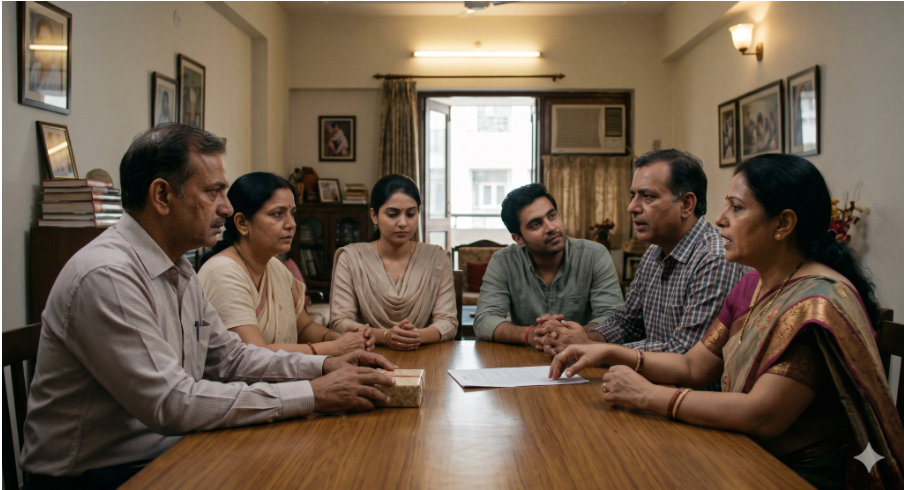
Is Dowry Legal in India? What the Law Actually Says
Many families in India still treat dowry as a normal part of wedding planning. But under Indian law, it is a criminal offence. If you are about to get married — or helping your child find a match — you need to know exactly where the law stands. Understanding this protects your family and helps you make better decisions during matrimony.
What Is Dowry Under Indian Law?
The Dowry Prohibition Act 1961 gives a clear definition. Dowry means any property or valuable security given or agreed to be given — directly or indirectly — by one party to a marriage to the other. This includes property given by the parents or relatives of either side.
The key word is "demand." When property or money is expected as a condition of marriage, it becomes dowry. It does not matter if it is called a "gift" or "tradition." If there is pressure or expectation attached, the law treats it as dowry.
Is Giving Dowry a Crime in India?
Yes. Both giving and taking dowry are criminal offences under the Dowry Prohibition Act 1961. Many families assume only the groom's side is guilty, but the law applies to both parties.
The Act makes it clear: no one can give, take, or help arrange dowry. Even agreeing to give dowry before a wedding is punishable. So if a family promises cash or gold under pressure, that promise itself is illegal.
Punishment for Dowry Under the Law
| Offence | Relevant Law | Punishment |
|---|---|---|
| Giving or taking dowry | Dowry Prohibition Act 1961, Section 3 | Minimum 5 years imprisonment + minimum ?15,000 fine or the dowry value (whichever is higher) |
| Demanding dowry | Dowry Prohibition Act 1961, Section 4 | Minimum 6 months, up to 2 years imprisonment + ?10,000 fine |
| Dowry harassment by husband or in-laws | Section 498A IPC | Up to 3 years imprisonment + fine |
| Dowry death (within 7 years of marriage) | Section 304B IPC | Minimum 7 years, up to life imprisonment |
These are not light penalties. The law is serious, even if enforcement remains inconsistent across India.
Dowry Is Illegal — So Why Is It Still Practiced?
This is the most honest question to ask. The gap between law and practice is wide in India. Social pressure, fear of losing a "good match," and deeply rooted family expectations keep the system alive.
Families often frame dowry as voluntary tradition. They use words like "shagun," "helping the couple settle," or "what we are happy to give." But when these amounts are discussed as conditions — before the wedding date is fixed — they cross into illegal territory.
The legal line is crossed when property becomes a condition, not a genuine gesture of love.
What Is Section 498A IPC?
Section 498A of the Indian Penal Code deals with cruelty by a husband or his relatives toward a wife. This includes harassment for dowry demands after marriage. It is a cognisable, non-bailable offence, which means police can arrest without a warrant.
This section exists because dowry demands do not always happen before the wedding. Many women face pressure, threats, or abuse after marriage when in-laws feel the dowry was insufficient. Section 498A gives women a direct legal remedy in such situations.
What Is a Dowry Death?
Section 304B IPC defines dowry death as the death of a woman within seven years of marriage, caused by burns, bodily injury, or under suspicious circumstances — where it is shown she was subjected to dowry-related cruelty or harassment.
In such cases, the husband and in-laws are presumed guilty unless proven otherwise. This reversal of the usual burden of proof reflects how seriously Indian law treats dowry-related violence.
If a woman dies under suspicious circumstances within seven years of marriage, the law automatically examines whether dowry harassment was involved.
Dowry vs Gifts: What Is the Difference?
This is where many families get confused. Not every gift given at a wedding is dowry. Indian weddings involve an exchange of gifts on both sides, and this is a long-standing cultural practice. The law recognises this distinction.
Here is how to tell them apart:
- Dowry: Property or money given as a condition of marriage, under pressure or expectation, regardless of what it is called
- Gifts: Voluntary presents given out of affection, with no conditions attached, listed in a signed document at the time of giving
The Dowry Prohibition Act requires that any gifts given at the time of marriage be listed in a written document. The list should include a description of each gift, its approximate value, the name of the person giving it, and the relationship to the bride or groom.
If gifts are not documented in this way, they can be challenged or treated as dowry in a legal dispute.
Is Stridhan the Same as Dowry?
No. Stridhan and dowry are different. Stridhan refers to property that belongs exclusively to the woman — jewellery, gifts received at the time of marriage, or any assets she owned before marriage. It is hers by right and cannot be taken from her.
Dowry, on the other hand, goes to the groom's family. The woman has no ownership over it.
This distinction matters legally. If a woman's stridhan is withheld or misappropriated by her in-laws, she can file a complaint separately. Many women confuse the two, which is why knowing the difference helps.
How to Report a Dowry Demand
If you or someone you know is facing a dowry demand, here are the steps to take:
- Document everything. Save messages, call recordings, or written communications where demands are made.
- Visit your nearest police station. File a complaint under the Dowry Prohibition Act or Section 498A IPC depending on the situation.
- Contact a Dowry Prohibition Officer. Every state in India is required to appoint these officers to receive and investigate dowry complaints.
- Reach out to a legal aid cell or women's helpline. The national women's helpline number is 181. You can also call 112 in an emergency.
- Consult a lawyer. A family law advocate can guide you on the right sections to invoke and help you build your case.
You do not need to wait until harm is done. A demand itself is a punishable offence.
Why This Matters When You Are Looking for a Match
When you are searching for a life partner — for yourself or your child — the question of dowry comes up earlier than most families expect. It often surfaces during the first few meetings, disguised as talk about "future plans" or "what both families can contribute."
Learning to recognise these signals early saves everyone from a painful situation later. A family that brings up financial expectations in the first conversation is telling you something important about how they see the marriage.
Compatibility, shared values, and mutual respect matter far more than qualifications or assets. A match built on genuine understanding lasts. A match built on financial negotiation rarely does.
Finding a Match Without the Dowry Pressure
More and more families today are choosing to step away from this system entirely. They are looking for matrimony platforms that focus on real compatibility — values, communication, life goals, and family culture.
Marriage Jodi is built around that approach. When you explore profiles on Marriage Jodi, the focus stays on finding someone who is genuinely right for you — not on what either family will bring to the table financially. It is a space where families can have honest conversations and make decisions with clarity.
If you want a marriage that starts on solid ground, the first step is rejecting the dowry equation entirely.