Experience the Magic: Why a Tamil Wedding is Unmissable
A Tamil wedding is more than just a ceremony; it is a sensory awakening that begins long before the sun comes up. Unlike modern parties that focus on late-night dancing, a marriage event Tamil style is deeply rooted in ancient Vedic traditions. It is a celebration of nature, family, and spiritual duty.
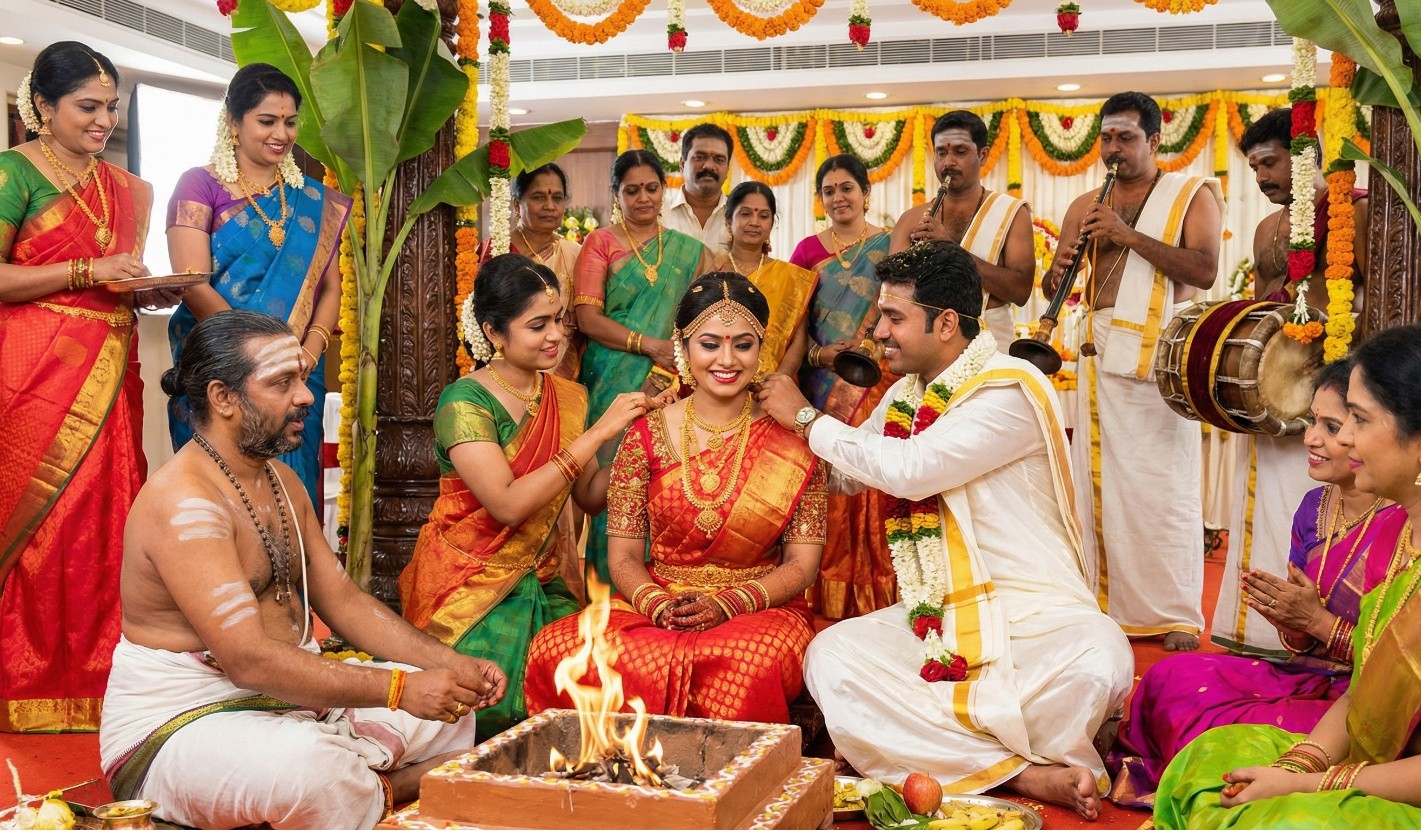
If you want to know what is the tradition of wedding in Tamil culture, think of it as a series of rituals honoring the five elements—earth, fire, water, air, and space. The day starts during the Brahma Muhurtham (often around 4:30 AM), a time considered perfect for new beginnings. The air fills with the smell of jasmine flowers and burning camphor. The loud, happy sounds of the Nadaswaram (a wind instrument) and Thavil (drum) create an energy you can feel in your bones.
For anyone attending a wedding in India, this is the most authentic experience you can get. It is not about showing off money. It is about honoring Dharma (duty). Every step, from the exchange of garlands to the vows around the fire, has a specific meaning. It binds two souls together for seven lifetimes. It is vibrant, emotional, and very disciplined. It is a must-attend event because it feeds your soul with culture and your stomach with the best food you will ever eat. Platforms like Marriage Jodi often highlight these beautiful traditions to help new couples understand their heritage.
The Atmosphere: Waking Up to Culture
Let's be honest. Most people hate waking up early. In fact, the 4 AM start time is the main reason for not attending wedding rituals for many guests. But if you hit the snooze button, you miss the magic.
Walking into a Tamil wedding hall at dawn is like entering a different world. The city outside is quiet, but inside, it is a festival. Women shine in heavy Kanjeevaram silk sarees. Men look sharp in white Veshtis (dhotis). The priest chants mantras that are thousands of years old.
The energy in the morning is pure. You don't feel tired. You feel energized by the colors and the sounds. It is very different from Western weddings. Here, the celebration is about waking up to a new life, quite literally.
A Timeline of Tradition: What Actually Happens?
If you are curious about what happens during a Tamil wedding, get ready for a marathon. The rituals are detailed and can span 2-3 days.
Here is a simple breakdown of the key tamil wedding events you will see:
- Panda Kaal Muhurtham: This happens a day or two before the wedding. Both families pray to a bamboo pole and plant it at the entrance. This is to ask God for a smooth event without any obstacles.
- The Oonjal (Swing Ceremony): This is a favorite for guests. The bride and groom sit on a swing. Married women from the family sing traditional songs. They feed the couple milk and bananas and throw colored rice balls around them to remove any "evil eye." It is playful and very sweet.
- Kasi Yatra: This is a dramatic and funny ritual. The groom wears sandals, carries an umbrella, and pretends he is walking away to Kasi (Varanasi) to become a monk. The bride's father stops him at the door. He begs the groom to stay and marry his daughter. The groom "agrees" and comes back to the mandap.
- Maalai Matrual: The couple exchanges heavy flower garlands three times. It sounds simple, but it is often a fun game. The bride and groom try to dodge the garland or get lifted up by their friends to make it harder.
- Kanyadaanam: The most emotional moment. The father places his daughter's hand in the groom's hand. He officially gives her away.
- Saptapadi: The couple takes seven steps around the holy fire. These are the seven vows of marriage. They promise friendship, food, and loyalty to each other.
The Golden Bond: Significance of the Thali
The most important part of the ceremony is the Thali. You will often hear people ask, "What is the significance of Thali in Tamil wedding?"
The Thali (also called Thirumangalyam) is not just jewelry. It is the soul of the marriage. It represents the husband's long life, the wife's dignity, and the strength of their bond. Unlike a ring that can be taken off, the Thali is worn close to the heart forever.
Who Gives Mangalsutra to a Bride?
This is a beautiful team effort. The question of "Who gives mangalsutra to a bride?" has a unique answer. The groom brings the Thali, but he ties only the first knot. His sister then steps in to tie the remaining two knots.
This shows that the marriage is not just between two people. It is between two families. The three knots represent the union of the mind, spirit, and body.
Is Tamil Mangalsutra Different from Others?
Yes, it is very unique. Is Tamil mangalsutra different from others? Absolutely.
- North India: You usually see black beads with a diamond or gold pendant.
- Tamil Nadu: It is usually a thick yellow thread (Manjal Kayiru) or a gold chain. The pendant shape varies by community. It could be a Tulsi leaf, a Shiva Lingam, or a tiger's claw. It is usually tucked inside the saree, kept private and sacred.
Tradition vs. Modernity: The Sindoor Question
If you watch Bollywood movies, you might expect the groom to put red powder in the bride's hair. But, do Tamil brides wear sindoor?
Traditionally, no. In Tamil culture, the signs of a married woman are the Thali, the toe rings (Metti), and the red dot (Kungumam) on the forehead. They do not typically apply sindoor in the hair parting (Maang) like North Indian brides. However, India is diverse. Some modern families might mix traditions, but it is not a core Tamil ritual.
Family Roles: The Groom's Sister
In many cultures, the best man or maid of honor has a big role. In a Tamil wedding, that spotlight belongs to the groom's sister.
What is the role of groom's sister in Tamil wedding? She is the bridge between the two families.
- Tying the Knots: As mentioned, she helps tie the Thali.
- The Best Friend: She walks with the bride during the Kasi Yatra and other rituals.
- Gifts: Because she helps the bride so much, the bride's family honors her with special gifts. Often, she gets a grand silk saree. It is a way of saying, "Thank you for welcoming our daughter."
Guest Guide: What to Wear and Bring
Attending a wedding in India can be confusing if you don't know the rules. Here is how to fit in perfectly at a Tamil wedding.
What to Wear to a Tamil Wedding as a Guest?
The dress code is "Tradition."
- For Women: Silk is the best choice. A Kanjeevaram saree is perfect. If draping a saree is too hard, a silk Salwar Kameez or a Lehenga works too. Wear bright colors like red, green, orange, or yellow. Avoid pure black or pure white. Some elders view these colors as bad luck for weddings.
- For Men: The classic look is a white shirt and a Veshti (white dhoti) with a gold border. If you are worried about the dhoti falling off (it happens!), wear formal trousers and a shirt. But wearing a Veshti earns you major respect.
What Gifts are Typically Given at a Tamil Wedding?
You don't need to carry a heavy box.
- Cash (Moi): This is the most practical and accepted gift. Put cash in a decorative envelope.
- The Lucky Number: Always add one rupee to the amount. Give ?501, ?1001, or ?5001. The extra rupee signifies that the wealth should continue to grow and not end at a round figure.
- Gold: For close family, small gold coins or jewelry are common.
The Hospitality of Unknown Weddings
Sometimes, you might find yourself invited to a wedding where you don't really know the couple. Maybe a neighbor invited you, or it's a village event.
Attending unknown marriage tamil style is an adventure you should say "Yes" to. In Tamil villages, a wedding is a community event. The host is happy just to feed you. There is a saying, Atithi Devo Bhava (The guest is God). Even if you don't know the bride's name, you will be welcomed with a smile and served a feast. It is a humbling experience to see such unconditional hospitality.
The Grand Finale: The Feast (Elai Sappadu)
You cannot write about a Tamil wedding without describing the food. This is not a buffet where you stand and eat. You sit in rows, and food is served on a fresh banana leaf.
It is a sensory explosion.
- The Leaf: The top half is for sides (salt, pickle, salad), and the bottom is for the main course.
- The Courses: First comes the sweet (Payasam), then rice with Sambar, then Rasam (pepper soup), and finally yogurt (Curd).
- The Etiquette: Eat with your right hand. It connects you to the texture and temperature of the food. When you are done, fold the leaf towards you to show you enjoyed the meal.
Why You Must Go
So, why is a Tamil wedding a must-attend? Because it is real. It is not staged for photos; it is performed for the gods.
From the vibration of the mantras to the taste of the tamarind rice, everything has a purpose. It reminds you that marriage is hard work, supported by family and faith. Whether you are finding your own path on sites like Marriage Jodi or just attending as a guest, witnessing these rituals reminds you of the beauty of commitment. So, the next time you get that invite, wake up early, put on that silk saree, and go witness the magic.
Frequently Asked Questions (FAQs)
1. What is the tradition of wedding in Tamil?
It is a Vedic ceremony focused on rituals performed around a holy fire. It emphasizes family unity, waking up early during Brahma Muhurtham, and honoring natural elements. Simplicity and devotion are key.
2. What happens during a Tamil wedding?
Key events include the Panda Kaal (blessing the venue), Oonjal (swing ceremony), Kasi Yatra (groom's mock pilgrimage), Kanyadaanam (giving away the bride), and Mangalyadharanam (tying the Thali).
3. What is the significance of Thali in Tamil wedding?
The Thali represents the marital bond. It is a sacred yellow thread or gold chain that symbolizes the wife's prayers for her husband's well-being and her own dignity.
4. Who gives mangalsutra to a bride?
The groom presents the mangalsutra. He ties the first knot, and his sister ties the remaining two knots, symbolizing the bride's acceptance into the new family.
5. Do Tamil brides wear sindoor?
Traditionally, no. Tamil brides wear a red dot (Kungumam or Bindi) on the forehead. They do not typically apply vermillion in the hair parting like in North Indian traditions.
6. What to wear to a Tamil wedding as a guest?
Women should wear silk sarees or traditional suits in bright colors. Men should wear a white shirt with a Veshti (dhoti) or formal trousers.
7. What is the role of groom's sister in Tamil wedding?
She is a key support figure. She participates in rituals like the Oonjal, helps the bride get ready, and ties the final knots of the Thali.
8. Is Tamil mangalsutra different from others?
Yes. Unlike the black beads common in the North, the Tamil Thali is typically a gold pendant on a yellow thread or a gold chain. The pendant shape varies by community.
9. What gifts are typically given at a Tamil wedding?
Cash gifts (ending in ?1, like ?501) are the most popular. Gold jewelry and silk clothes are also traditional choices for close family.
10. Is it okay to attend a wedding if I don't know the couple well?
Yes! Attending unknown marriage tamil style is common. Guests are treated with great respect and served food with love, regardless of how well they know the family.