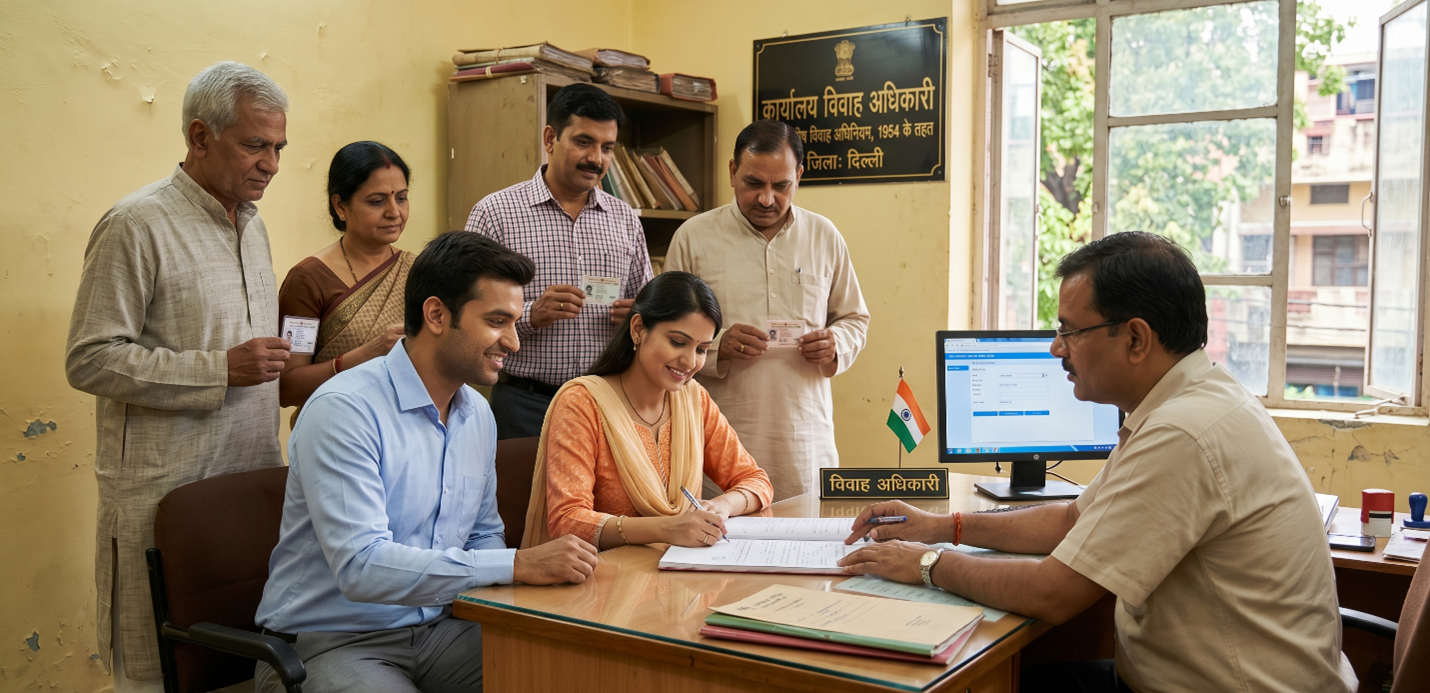
What Is Court Marriage in India? Process, Documents, Fees and Rules Explained
Court marriage is one of the most searched topics among couples planning to marry in India, especially those looking for a simple, legal, and hassle-free process. Whether you are from different religions, different states, or simply want a legally registered union without a big ceremony, court marriage is a practical path.
This guide explains everything you need to know, from what court marriage actually means to its process, fees, documents, and who it applies to.
What Is the Meaning of Court Marriage?
Court marriage is a legally recognised marriage registered under the Special Marriage Act, 1954. It is a civil marriage conducted in the presence of a Marriage Officer and three witnesses. Unlike religious ceremonies, it does not require any rituals, priests, or community involvement.
The term 'court marriage' is commonly used in India, though the official term is a marriage registered under the Special Marriage Act. It is valid across India regardless of the religion, caste, or community of the couple.
This is why court marriage is especially popular among inter-caste couples, inter-religion couples, and those who want a straightforward legal marriage without social pressure.
What Is the Difference Between Court Marriage and Registered Marriage?
Many people use the two terms together, but there is a difference worth understanding. Here is a clear comparison:
| Aspect | Court Marriage | Registered Marriage |
|---|---|---|
| Law Used | Special Marriage Act, 1954 | Hindu Marriage Act or personal law of the community |
| Religion Requirement | Not required. Open to all religions | Typically applies to specific religion |
| Ceremony Required | No. Only a signed declaration before an officer | Usually yes, through a religious ceremony |
| Inter-Religion Allowed | Yes, fully valid | Not typically applicable |
| Validity | Legally valid across India | Valid, but may need re-registration in some states |
| Processing Time | 30 days notice period required | Varies by state and registration type |
| Witnesses Needed | Three adult witnesses | Typically two witnesses |
So a registered marriage is usually the legal recording of a religious ceremony. Court marriage, by contrast, is a fully civil process that stands on its own without any religious element.
What Is Court Marriage in India: The Legal Basis
Court marriage in India is governed by the Special Marriage Act, 1954. This law applies to all citizens of India, regardless of religion. It was introduced to enable marriages between people of different faiths and communities in a legally binding way.
The act also allows people who have had a religious wedding to additionally register it under this law for stronger legal protection. This is useful for property rights, inheritance, visa applications, and other official purposes.
What Are the Court Marriage Rules in India?
There are clear rules under the Special Marriage Act that both parties must follow. Knowing these in advance helps you avoid delays or rejection.
Eligibility Conditions
- Neither party should already be married. If previously married, the spouse must have died or the divorce must be legally finalised.
- Both parties must be mentally sound and capable of giving valid consent.
- The parties must not be related within the degrees of prohibited relationship as defined under the Act.
- Both must be Indian citizens. For NRIs, additional documentation may be required.
Court Marriage Age Rules
The minimum court marriage age in India is 21 years for men and 18 years for women. This is as per the Special Marriage Act, 1954. Proof of age is a mandatory document during the application process.
It is worth noting that the Prohibition of Child Marriage Act, 2006 also applies alongside this, which means any marriage below these ages is not legally valid regardless of how it is conducted.
Court Marriage Process: Step by Step
The court marriage process in India follows a set sequence. It takes a minimum of 30 days from the date of giving notice, but in practice it may take longer depending on the district and the officer's schedule.
Step 1: Give a Notice of Intended Marriage
Both parties visit the office of the Marriage Officer in the district where either of them has lived for at least 30 days. They fill in the notice form and submit it along with the required documents.
Step 2: The Notice Is Published
The Marriage Officer publishes the notice on a notice board. This is an open notice that gives any person the right to object to the marriage within 30 days if they have a valid legal reason.
Step 3: Wait for the 30-Day Period
If no objection is raised within 30 days, the marriage can proceed. If an objection is raised, the officer investigates it. This can extend the timeline.
Step 4: Sign the Declaration and Solemnise the Marriage
Both parties and three witnesses appear before the Marriage Officer on the appointed date. Each person signs a declaration confirming they meet the legal requirements. The officer then solemnises the marriage.
Step 5: Receive the Marriage Certificate
After the formalities are complete, the Marriage Officer issues a marriage certificate. This certificate is legally valid across India and is accepted by all government bodies, banks, and embassies.
Court Marriage Documents Required
Submitting the right documents is essential. Missing paperwork is the most common reason for delays. Here is what both parties typically need to provide:
| Document | Purpose |
|---|---|
| Age proof (Aadhaar, birth certificate, class 10 marksheet) | To verify both parties meet the minimum age requirement |
| Address proof (Aadhaar, voter ID, passport, utility bill) | To confirm residence in the district for 30 days |
| Recent passport-size photographs | For the application form and marriage certificate |
| Divorce decree or death certificate of previous spouse (if applicable) | To confirm neither party is in an existing valid marriage |
| Identity proof (Aadhaar card, PAN card, passport) | Standard identity verification |
| Affidavit confirming eligibility | A self-declaration signed by both parties |
| Proof of witnesses (3 witnesses with ID proof) | Required for the solemnisation step |
Documents must be self-attested. In some states, a notarised affidavit may also be required. Check with your local sub-registrar office for the exact list in your district.
Court Marriage Fees in India
Court marriage fees are relatively low compared to the cost of a traditional wedding or even a lawyer-assisted registration process. The official court marriage fees vary slightly by state, but the typical structure looks like this:
| Fee Type | Approximate Amount |
|---|---|
| Notice of Intended Marriage filing fee | Rs. 150 to Rs. 200 |
| Marriage solemnisation fee | Rs. 150 to Rs. 500 |
| Marriage certificate fee | Rs. 50 to Rs. 100 |
| Affidavit notarisation (if required) | Rs. 100 to Rs. 200 |
| Total approximate cost | Rs. 500 to Rs. 1,000 |
What is the total cost for court marriage in India when you include legal support? If you hire a lawyer or a document assistance service to guide you through the process, costs may rise to Rs. 5,000 to Rs. 15,000. But the government fees themselves remain low.
Is Court Marriage a Good Idea?
For many couples, yes. Court marriage is a good idea when you want a legally solid marriage without spending on ceremonies or depending on community approval. It is especially useful in the following situations:
- When the couple belongs to different religions or castes and family approval is difficult
- When both parties are working professionals who want a simple legal process
- When the couple is planning to move abroad and needs a legally registered marriage for visa purposes
- When a traditional ceremony is already planned but a legal registration is also needed
- When one or both parties are marrying for the second time after a divorce
That said, it is important to be realistic. Court marriage does not resolve family conflicts on its own. Some families may feel excluded or hurt if they are not involved in the decision. So it helps to have honest conversations before proceeding.
Can a Married Man Do Court Marriage?
No. A married man cannot do a court marriage while his previous marriage is still legally valid. Under the Special Marriage Act, polygamy is not permitted. Both parties must be unmarried, widowed, or legally divorced at the time of the court marriage.
If a person attempts to register a second marriage without a valid divorce, it is considered bigamy under Indian law, which is a criminal offence punishable under Section 494 of the Indian Penal Code.
If someone is separated from their spouse but not formally divorced, they must complete the divorce process first before proceeding with a court marriage.
Is It Compulsory to Do Court Marriage in India?
No, court marriage is not compulsory in India. Indian law recognises multiple forms of marriage. Hindu marriages conducted with religious rituals under the Hindu Marriage Act, 1955 are legally valid. Muslim marriages, Christian marriages, and Parsi marriages all have their own personal laws.
Court marriage becomes the chosen route when a couple wants a single legal process that is religion-neutral, or when their personal law does not easily cover their situation, such as in inter-religion marriages.
But you are not required by law to have a court marriage. What is required is that your marriage is registered. Many states now encourage or mandate registration of all marriages, regardless of how they were conducted.
What Are the 8 Types of Marriage in India?
Hindu scriptures describe eight types of marriage, though most of them are historical and not practised in modern India. Here is a brief overview:
| Type | Description | Still Practised? |
|---|---|---|
| Brahma | Father gives daughter to a worthy man of good character | Yes, most common arranged marriage form |
| Daiva | Daughter given to a priest as a gift for performing rituals | Rare |
| Arsha | Groom gives a cow and a bull to the bride's family | Very rare |
| Prajapatya | Marriage with mutual consent for fulfilling family duties | Yes, in principle |
| Gandharva | Marriage by mutual love and consent without rituals | Yes, equivalent to love marriage |
| Asura | Groom pays bride's family for the marriage | Discouraged by law |
| Rakshasa | Marriage by abduction or force | Illegal and punishable |
| Paishacha | Marriage by deception or when the girl is unaware | Illegal and punishable |
Of these, Brahma and Prajapatya reflect the modern arranged marriage. Gandharva is closest to a love marriage or court marriage in spirit. The last two are illegal under Indian law and are mentioned here only for historical reference.
Court Marriage vs Traditional Marriage: A Quick Comparison
| Aspect | Court Marriage | Traditional/Religious Marriage |
|---|---|---|
| Legal Basis | Special Marriage Act, 1954 | Personal law (Hindu, Muslim, etc.) |
| Ceremony | Not required | Usually mandatory |
| Time to Complete | Minimum 30 days from notice | Varies, can be done in a day |
| Open to All Religions | Yes | No, applies to specific community |
| Cost | Rs. 500 to Rs. 1,000 in government fees | Can range from thousands to lakhs |
| Certificate Issued | Yes, by the Marriage Officer | Yes, after separate registration |
| Family Approval Needed | Not legally, but advisable | Usually yes |
How Marriage Jodi Helps You Find a Partner Before Marriage
Whether you plan a court marriage or a traditional one, the first step is finding the right person. Marriage Jodi connects you with verified profiles from across India, covering all communities, religions, and educational backgrounds.
You can browse profiles, set your preferences, and connect with families who share your values. The platform is designed to help genuine people find genuine matches, which means the focus is always on compatibility and trust.
If you are planning a court marriage after finding your partner, the process becomes smoother when both families have had time to connect and communicate. A shared platform helps that happen at a comfortable pace.
Register free on MarriageJodi today and begin your search for a partner with whom you can confidently plan your future together.
Frequently Asked Questions
-
What is the meaning of court marriage?
Court marriage is a legally registered marriage conducted under the Special Marriage Act, 1954. It is a civil process that does not require any religious ceremony and is valid for all communities in India.
-
What is the court marriage process in India?
You submit a notice to the Marriage Officer, wait 30 days for the notice period, and then appear with three witnesses to sign the declaration. The Marriage Officer then solemnises the marriage and issues a certificate.
-
What are the documents required for court marriage?
Both parties need age proof, address proof, identity proof, passport-size photographs, and an affidavit. Three witnesses also need to bring their ID proof. If either party is divorced, a divorce decree is required.
-
What are the court marriage fees in India?
Government court marriage fees are typically between Rs. 500 and Rs. 1,000. If you hire a legal assistant or lawyer, the total cost can go up to Rs. 5,000 to Rs. 15,000.
-
What is the court marriage age in India?
The minimum age is 21 years for men and 18 years for women, as required under the Special Marriage Act, 1954.
-
Is court marriage compulsory in India?
No. Court marriage is not compulsory. But marriage registration is increasingly required in many states. You can also register a religious marriage separately through your local sub-registrar office.
-
Can a married person do court marriage?
No. Both parties must be unmarried, widowed, or legally divorced. A married person who attempts a second court marriage without a valid divorce commits bigamy, which is a criminal offence under Indian law.