Hindu Marriage Act 1955: Key Sections Explained Simply
The Hindu Marriage Act, 1955 is the main law that governs marriage among Hindus in India. It sets the rules for who can marry and how a marriage becomes valid. It also covers what happens if a marriage breaks down.
Most families never read the Act until they face a legal question. But knowing the basics helps you before marriage too. This guide explains the important sections of the Hindu Marriage Act in plain language, with simple examples.
This article is for general awareness. For a specific legal problem, please speak to a qualified family lawyer.
Who Does the Hindu Marriage Act Apply To?
Under Section 2, the Act applies to all Hindus. This includes Virashaivas, Lingayats and followers of the Brahmo, Prarthana or Arya Samaj. It also applies to Buddhists, Jains and Sikhs.
It does not apply to Muslims, Christians, Parsis or Jews. Their marriages follow their own personal laws.
Some Hindus want to marry a person of another faith without conversion. Such a marriage must happen under the Special Marriage Act, 1954. Our guide on whether a Christian can marry a Hindu explains this route.
Section 5: Conditions for a Valid Hindu Marriage
Section 5 lists five conditions. A Hindu marriage is valid only if all of them are met.
| Condition | What it means |
|---|---|
| No living spouse | Neither partner can have a living husband or wife at the time of marriage. |
| Sound mind | Both must be able to give valid consent and must not suffer from serious mental illness that makes married life impossible. |
| Minimum age | The groom must be at least 21 and the bride at least 18. |
| Not within prohibited degrees | Close blood relatives, such as siblings, cannot marry, unless a valid custom allows it. |
| Not sapindas | Partners cannot share a common ancestor within set generations, unless custom allows it. |
To understand why the ages are 21 and 18, read our article on marriage age in India.
Section 7: Ceremonies for a Hindu Marriage
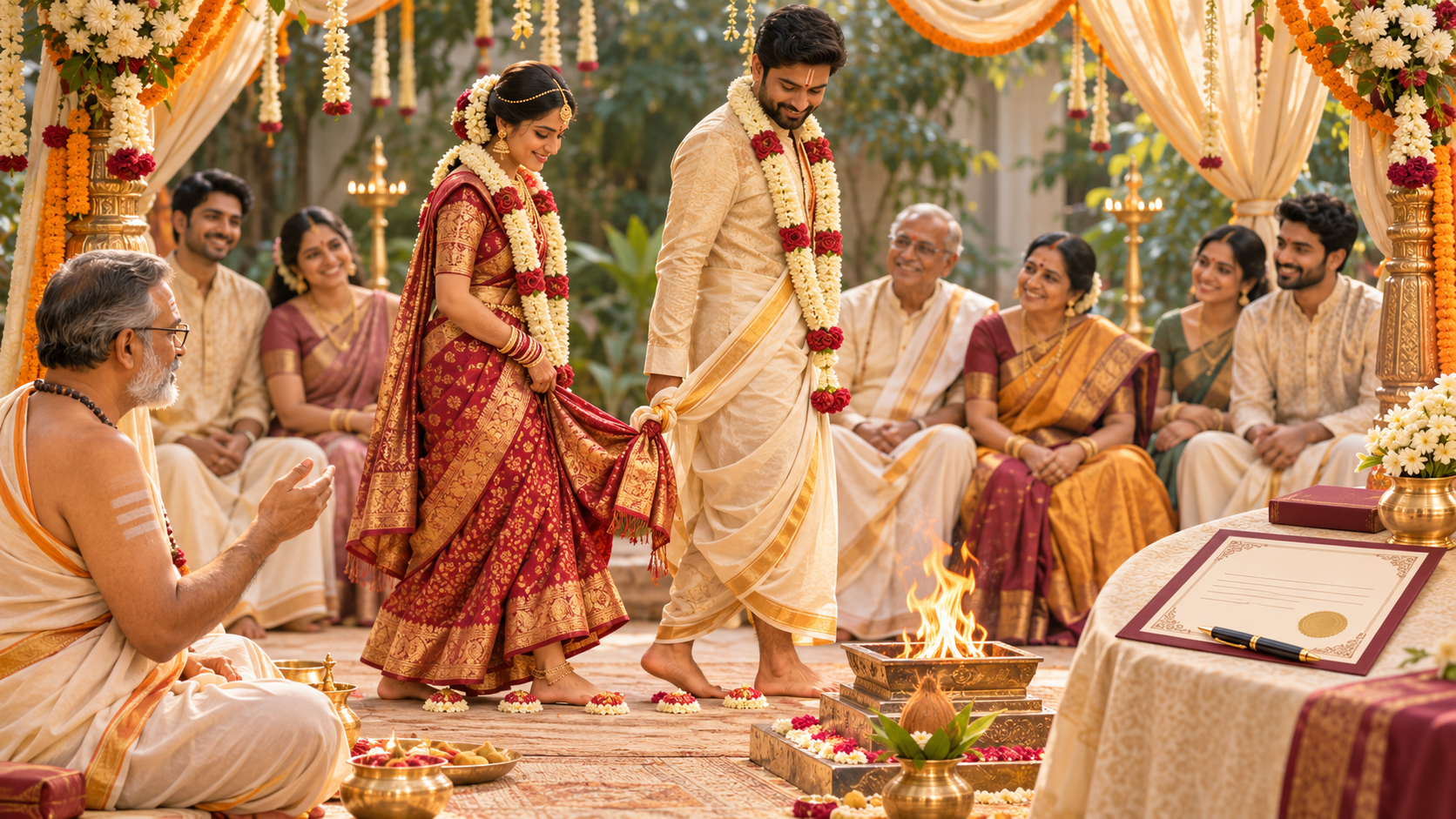
Section 7 says a couple can marry using the customary rites of either partner. There is no single fixed ritual for all Hindus.
Many rites include saptapadi. Here, the marriage is complete when the couple takes the seventh step around the sacred fire. This is why the saat phere are so important in North Indian weddings.
Section 8: Registration of Hindu Marriage
Section 8 lets couples register Hindu marriages, and state governments can make registration compulsory. The Supreme Court has also stressed that couples should register all marriages.
A marriage certificate is proof of marriage. You need it for a passport, a spouse visa, bank nominations and insurance claims. Registration does not make a marriage valid on its own, but it makes proving the marriage much easier.
Section 9: Restitution of Conjugal Rights
Section 9 is one of the most searched parts of the Act. Sometimes one spouse leaves without a reasonable excuse. The other spouse can then ask the court to order them to return.
The person who left must prove that they had a reasonable excuse. Courts look at the full situation, including any cruelty or harassment, before passing an order.
Sections 10, 11 and 12: Separation, Void and Voidable Marriages
Section 10 allows judicial separation. The couple stays legally married but is no longer required to live together.
Section 11 lists void marriages, which have no legal value from the start. A marriage is void if a partner already had a living spouse. It is also void if the couple are sapindas or within prohibited degrees.
Section 12 covers voidable marriages. These are valid until a court cancels them. Grounds include non-consummation due to impotence and consent taken by force or fraud. Another ground is a hidden pregnancy by another man at the time of marriage.
Section 13: Grounds for Divorce
Section 13 lets either spouse file for divorce on specific grounds. These include:
| Ground | Simple meaning |
|---|---|
| Adultery | Voluntary sexual relations with someone else after marriage |
| Cruelty, 13(1)(ia) | Physical or mental cruelty that makes living together unsafe or unbearable |
| Desertion, 13(1)(ib) | Leaving the spouse without reason for at least two years |
| Conversion | Ceasing to be a Hindu by converting to another religion |
| Mental disorder | Serious, incurable mental illness |
| Renunciation | Entering a religious order and renouncing the world |
| Presumed death | Not heard of as alive for seven years or more |
A wife has a few extra grounds under Section 13(2). One example is a husband marrying again while the first marriage is still valid.
Under Section 14, a spouse usually cannot file for divorce within one year of marriage. Courts allow exceptions only in cases of exceptional hardship.
Section 13B: Divorce by Mutual Consent
Section 13B allows a couple to end the marriage peacefully, if both agree. They must have lived separately for at least one year.
The couple files a joint petition. After that, there is normally a waiting period of six months before the second motion. The Supreme Court has said courts can waive this wait in suitable cases. One example is when there is no chance of reconciliation.
Sections 24 and 25: Maintenance and Alimony
Section 24 lets either spouse ask for interim maintenance and legal costs while the case is pending. This helps a spouse who has no independent income to fight the case fairly.
Section 25 deals with permanent alimony. At the end of a case, the court can order a lump sum or monthly payment. It looks at both partners' income, property and conduct before deciding.
Section 17: Bigamy Is a Crime
Under Section 17, a Hindu who marries again while their spouse is alive commits bigamy. The second marriage is void, and the person can face criminal punishment. Section 82 of the Bharatiya Nyaya Sanhita, 2023 now covers bigamy.
Hindu Marriage Act vs Special Marriage Act
| Point | Hindu Marriage Act, 1955 | Special Marriage Act, 1954 |
|---|---|---|
| Who can use it | Hindus, Buddhists, Jains, Sikhs | Any two Indians, any religion |
| Ceremony | Religious rites like saptapadi | Civil ceremony before a Marriage Officer |
| Notice period | No public notice needed | 30 days' public notice |
| Registration | After the ceremony | Part of the process |
Common Myths About the Hindu Marriage Act
Myth one says a temple wedding is not legal without a certificate. That is false. The wedding becomes valid once the couple completes the rites. The certificate is proof, not the marriage itself.
Myth two says you can divorce right after the wedding. In most cases, you must wait one year to file. Courts allow early cases only in rare hardship.
Myth three says only the wife can ask for maintenance. That is false too. Under Sections 24 and 25, either spouse can ask, if they need support.
Myth four says the Act covers all Indians. It does not. It covers Hindus, Buddhists, Jains and Sikhs only.
Why This Matters Before You Marry
Most people think about marriage law only when something goes wrong. But knowing the basics early helps you make better choices. It reminds you to check marital history honestly, register your marriage on time, and keep important documents safe.
On Marriage Jodi, profiles clearly show marital status. You can see if a person is never married, divorced or widowed. That openness makes conversations more honest from day one. You can also read our guide to court marriage in India if you prefer a simple civil ceremony.
Frequently Asked Questions
What is the Hindu Marriage Act 1955?
It is an Indian law that governs marriage, separation and divorce for Hindus, Buddhists, Jains and Sikhs. It sets conditions for a valid marriage and grounds for ending one.
What is Section 9 of the Hindu Marriage Act?
Section 9 deals with restitution of conjugal rights. If a spouse leaves without good reason, the other can ask the court to order a return.
What is Section 13 of the Hindu Marriage Act?
Section 13 lists the grounds for divorce. These include adultery, cruelty, desertion for two years, conversion, serious mental disorder, renunciation and presumed death.
What is Section 13B of the Hindu Marriage Act?
Section 13B allows divorce by mutual consent. Both spouses must live apart for at least one year. They must also jointly agree to end the marriage.
What is Section 24 of the Hindu Marriage Act?
Section 24 helps a spouse without enough income. That spouse can claim interim maintenance and legal costs while the case runs.
Is marriage registration compulsory under the Hindu Marriage Act?
Section 8 allows states to make registration compulsory, and many states have done so. Even where it is optional, registering your marriage is strongly advised.
Want a marriage built on honesty from day one? Create your free profile on Marriage Jodi.